
Graphics Card
Track Your Course Progress
You are currently studying as a guest. Your course progress and quiz results will not be saved unless you login to your EduCourse account. Login to track your progress and qualify for your certificate.
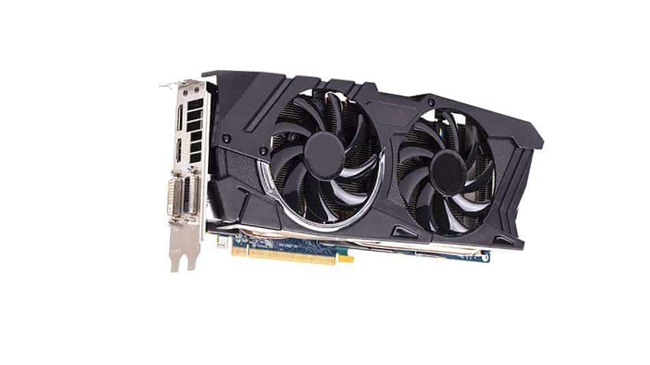
A graphics card, also known as a video card, GPU (Graphics Processing Unit), or graphics adapter, is a hardware component that generates and renders images, animations, and videos on a computer display. Here’s an overview of graphics cards:
1. Functionality:
- Graphics Rendering: The primary function of a graphics card is to render and display visual content on a computer monitor or other display devices. It processes graphical data from the CPU and converts it into signals that can be displayed as images on the screen.
- 3D Graphics Acceleration: Graphics cards include specialized processors and dedicated memory to accelerate 3D rendering tasks, such as gaming, computer-aided design (CAD), video editing, and virtual reality (VR) applications.
- Video Playback: Graphics cards support hardware-accelerated video decoding and playback, providing smooth playback of high-definition (HD) and ultra-high-definition (UHD) video content.
- Multiple Displays: Many graphics cards support multiple display outputs, allowing users to connect multiple monitors or displays for multitasking, gaming, and productivity purposes.
2. Types of Graphics Cards:
- Integrated Graphics: Integrated graphics are built into the computer’s CPU or motherboard chipset and share system memory for graphics processing. They are suitable for basic computing tasks, such as web browsing, document editing, and multimedia playback, but may lack the performance for demanding gaming or professional applications.
- Discrete Graphics: Discrete graphics cards are separate expansion cards installed in a computer’s PCIe (Peripheral Component Interconnect Express) slot. They feature dedicated GPU chips, video memory (VRAM), and cooling solutions for improved graphics performance and efficiency.
- Workstation/Graphics Processing Unit (GPU): Workstation GPUs are high-performance graphics cards designed for professional applications, such as CAD, 3D modeling, animation, scientific simulations, and content creation. They offer optimized drivers, certified software compatibility, and advanced features for professionals who require reliable and accurate rendering capabilities.
- Gaming/Graphics Processing Unit (GPU): Gaming GPUs are designed for gaming enthusiasts and offer high frame rates, realistic visuals, and immersive gaming experiences. They feature specialized gaming-focused features such as ray tracing, AI-powered rendering, and overclocking capabilities to enhance gaming performance and visual quality.
3. Features of Graphics Cards:
- GPU Architecture: Graphics cards use different GPU architectures developed by manufacturers such as NVIDIA and AMD. Common architectures include NVIDIA’s GeForce and Quadro series and AMD’s Radeon and Radeon Pro series.
- CUDA Cores/Stream Processors: Graphics cards contain parallel processing units called CUDA cores (NVIDIA) or stream processors (AMD) that perform calculations and render graphics. Higher core counts generally result in better performance in demanding applications.
- Memory: Graphics cards include dedicated video memory (VRAM) to store and manipulate graphical data. GDDR (Graphics Double Data Rate) memory types such as GDDR6 and HBM (High Bandwidth Memory) offer high-speed data transfer rates for improved graphics performance.
- Clock Speeds: Graphics cards feature base and boost clock speeds that determine the frequency at which the GPU operates. Higher clock speeds result in faster rendering and improved gaming performance.
- Cooling Solutions: Graphics cards come with various cooling solutions, including fans, heat sinks, and liquid cooling systems, to dissipate heat generated by the GPU during operation and maintain optimal temperature levels.
- Connectivity: Graphics cards offer display outputs such as HDMI, DisplayPort, DVI, and VGA to connect monitors and displays. They may also include additional features like USB-C ports, virtual link connectors, and audio outputs.
