
Qualitative vs Quantitative Risk Assessment Methods
Understanding Qualitative and Quantitative Risk Assessment Methods
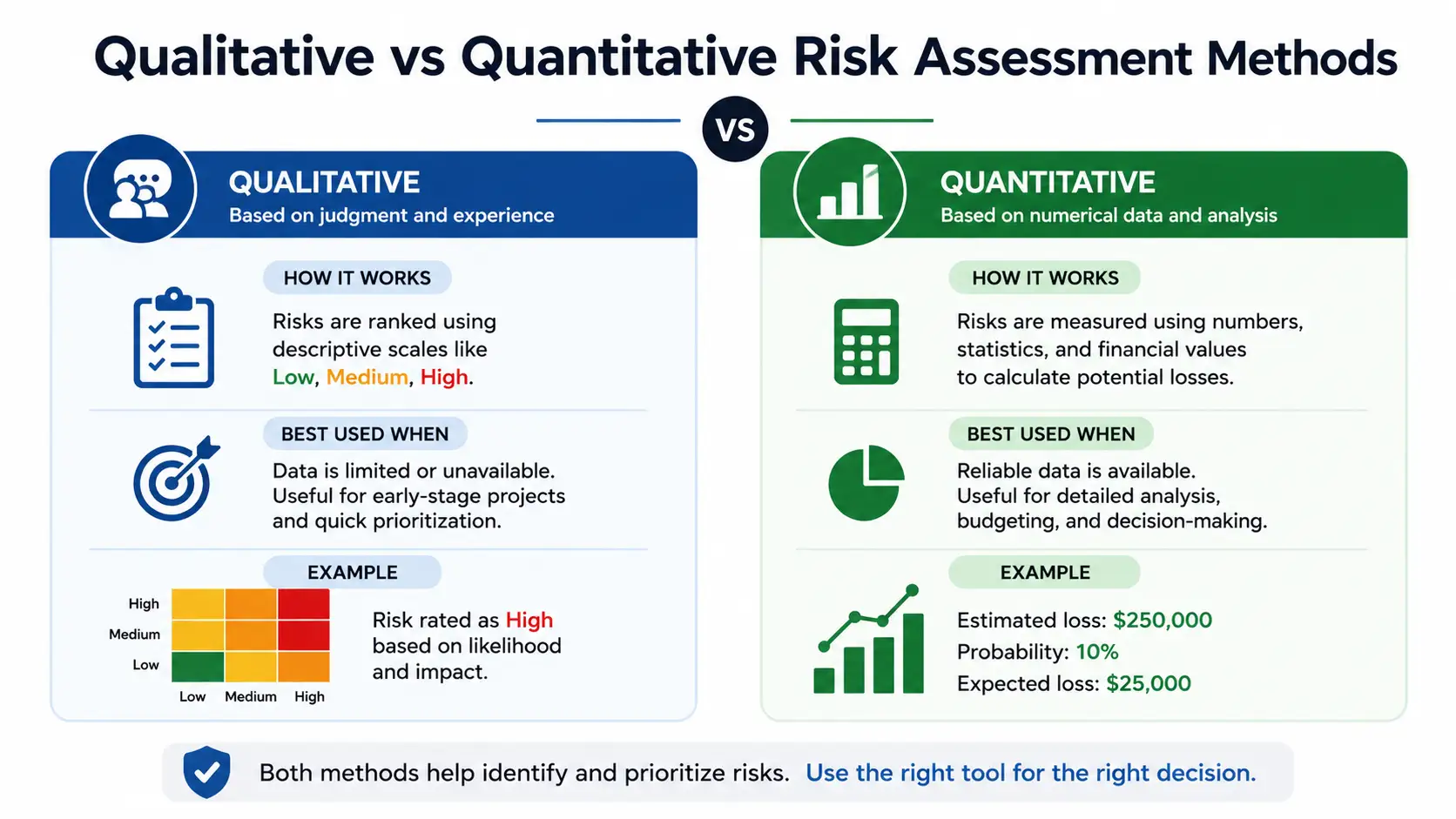
Qualitative vs Quantitative Risk Assessment Methods are two important ways to identify and evaluate risks in any project or workplace. Both help you understand the chance of a problem happening and how serious it could be. The choice depends on the situation, available data, and resources.
Qualitative Risk Assessment is based on opinions, experience, and judgement. It uses descriptive terms like high, medium, or low risk. This method is quick and easy to use. It helps when you do not have hard data or when risks are hard to measure with numbers.
This method usually involves tools like checklists, interviews, or risk matrices. For example, a team may discuss possible hazards and agree on their impact and likelihood. The result is a simple risk ranking that guides action but does not give exact values.
Key Features of Qualitative Assessment
- Uses descriptive categories
- Relies on expert opinion
- Easy and fast
- Good for early risk screening
- Less precise
Quantitative Risk Assessment uses numbers and data. It measures risk by calculating probabilities and potential losses. This method needs more information, such as past records, statistics, or detailed models.
Quantitative assessments are more exact. They might use formulas or software to estimate the expected cost or time delay caused by risks. This helps in making detailed decisions and comparing different risks clearly.
Key Features of Quantitative Assessment
- Uses numerical data and statistics
- More precise and measurable
- Can estimate financial impact
- Needs more time and resources
- Useful for complex or high-value projects
In summary, Qualitative vs Quantitative Risk Assessment Methods both play vital roles. Qualitative is practical for quick checks and when data is limited. Quantitative is better for detailed analysis and when accurate figures are needed.
Knowing when to use each helps you manage risks effectively, making workplaces or projects safer and more reliable.
